For nearly 40 years, we have brought together people who use and care about Clissold Park.
Our surviving records tell the story of a volunteer group whose work has ranged from campaigning for the restoration of Clissold House and the park to organising events, scrutinising proposals, raising money, supporting wildlife projects and representing park users in discussions with Hackney Council. Some campaigns produced visible changes; others continued for years or did not achieve what members hoped for.
What runs through the archive is the idea of the User Group as a public forum: a place where people can find out what is happening in the park, question those responsible for it, suggest improvements and sometimes help make things happen themselves.
This history is based on surviving newsletters, minutes, reports, correspondence, photographs and other archive material. The record becomes much fuller from the 1990s onwards, but there are gaps, particularly in our earliest years.
The beginnings of the User Group
Exactly when Clissold Park User Group was established remains uncertain.
The earliest surviving records so far identified date from 1989, when representatives of the User Group were already discussing the future of Clissold House with Hackney Council. This tells us that the organisation existed by then, but not when it was founded.
Later records identify Christine Disney, who died in 2004, as a founder member and former chair. She is documented as chair in 1989. Other surviving material names John Field and St John O’Rourke among the early chairs, although their dates and the order in which they served have not yet been established.
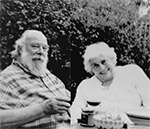
Larraine Worpole chaired the group from 1994 to 1997. She was succeeded in 1998 by her husband, Ken Worpole, who remained chair until March 2011 and is the group’s Honorary President today. Larraine died in 2025.
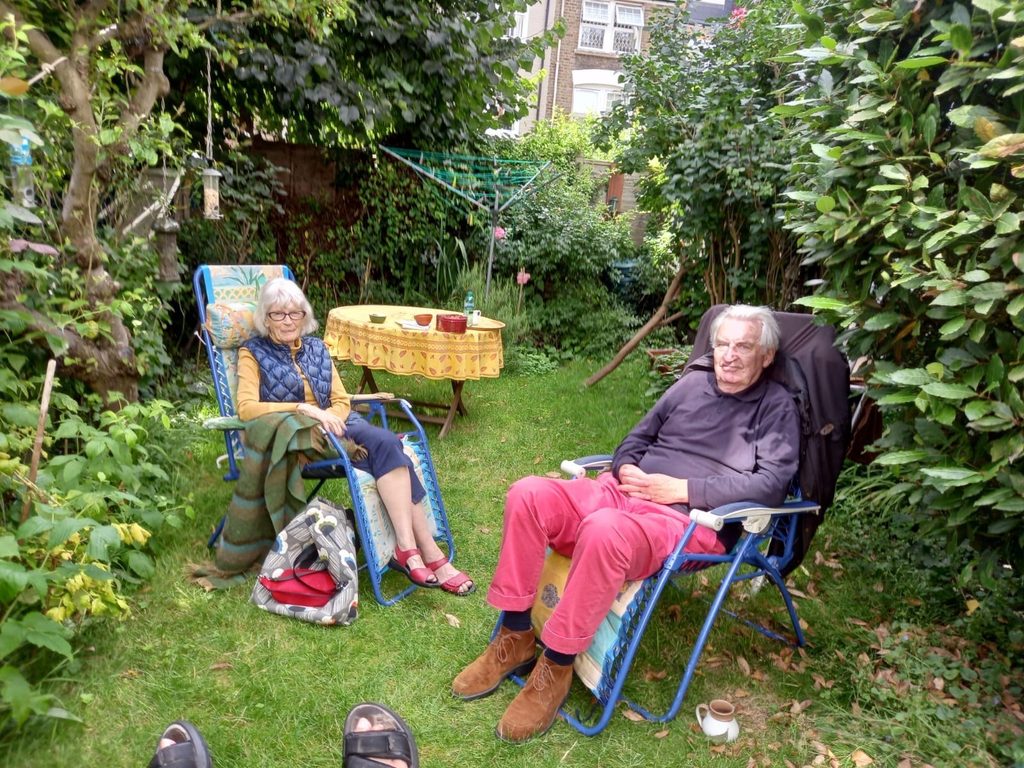
By the mid-1990s, the surviving records provide a much clearer picture of an established community organisation concerned with almost every aspect of the park.
From the beginning of the surviving record, one subject was particularly persistent: the future of Clissold House.
A long campaign for Clissold House
By 1989 CPUG was discussing repairs, maintenance and possible uses of the House with the Council. During the 1990s those concerns developed into a sustained attempt to find a future for a building that had deteriorated over many years.
In 1993 members helped establish the Friends of Clissold House, initially exploring whether a charitable trust could provide a way of raising money for refurbishment. This later developed into the Clissold House Trust in 1996.
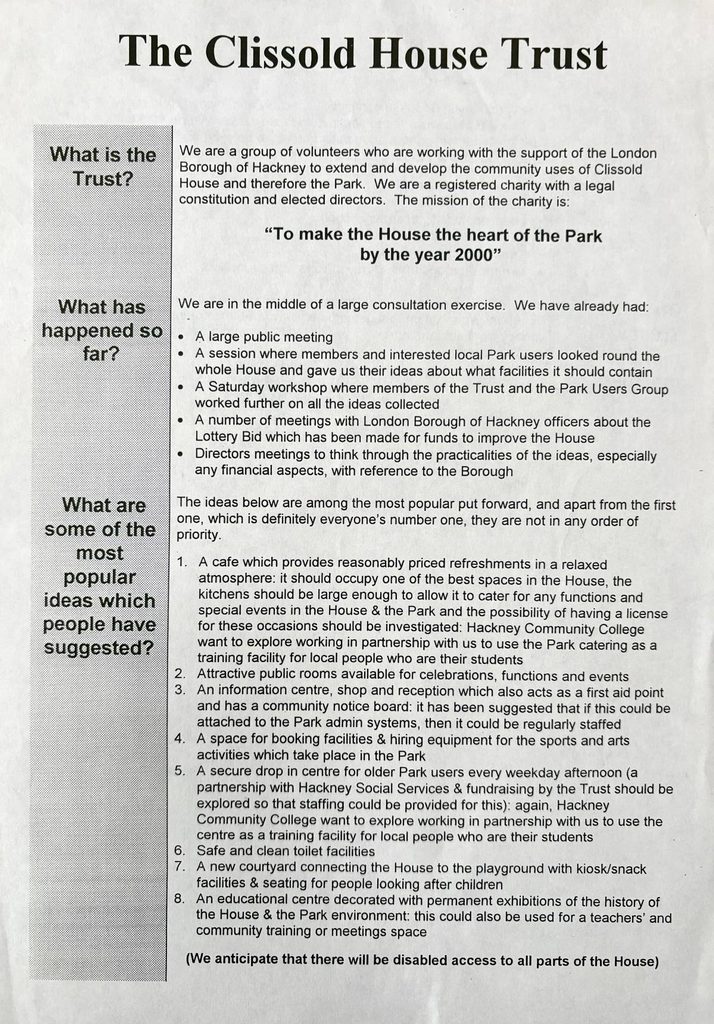
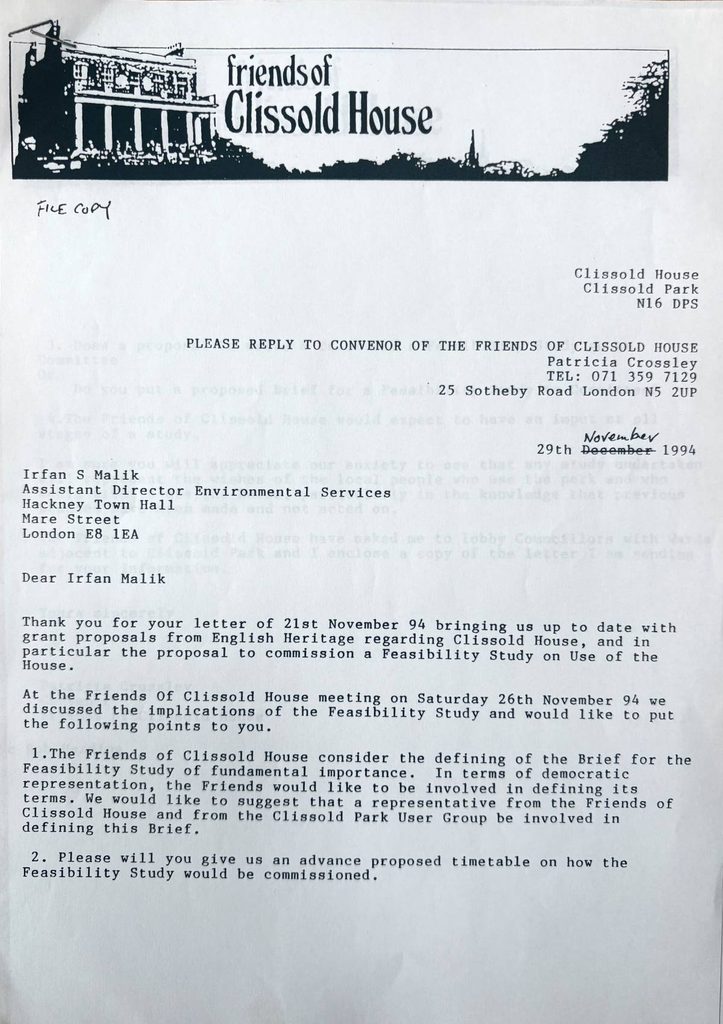
Members investigated possible uses for the House, sought professional advice, commissioned and contributed to feasibility work, promoted public consultation and pursued funding. Several schemes and funding attempts came and went.
The House campaign was substantial, but it was never the whole story of the User Group. The archive from the same period shows members dealing with the everyday life of the park at the same time.
Life in the park in the 1990s
The records from the 1990s can sometimes feel like sitting in on the meetings themselves.
Members raised complaints about dog mess and loose dogs, cars entering the park, cyclists travelling too fast, graffiti and children playing football on the bowling green. There were arguments about staffing and patrols and concern about damage to the paddling pool caused by winter hockey. Alongside these problems were plans for a new playground, work around the animal enclosure and attempts to create more opportunities for people to experience the park’s wildlife.
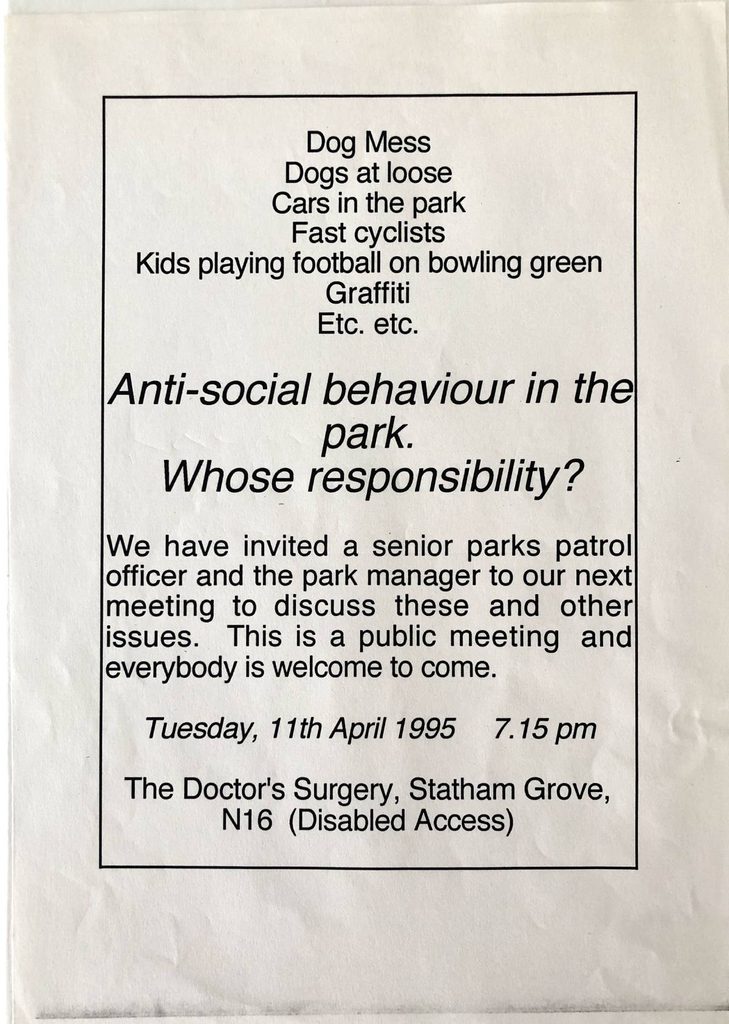
Surviving notices from 1995-6 provide a particularly good glimpse of this side of CPUG.
On 7 May 1996, rather than meeting indoors, the User Group invited people to gather at the animal enclosure and meet park staff. The subjects included plans for the enclosure, the Butterfly Project, natural habitats, hands-on activities and pond dipping.
Two months later, CPUG and the London Wildlife Trust organised A walk in the park, led by Clissold Park animal keeper Caroline Richards. Visitors were shown the new Nature Garden and Butterfly Tunnel and the hands-on area of the animal enclosure before walking through the park to look at its trees, water features and pond life. The invitation said simply: “Everyone welcome.”
Recreation mattered too. An August meeting invited members of Clissold Park Bowls Club to explain the bowling green, how to join and an offer of free coaching. In September, Hackney Parks Service, CPUG and the Bowls Club followed this with two free bowls open days.
But the August agenda moved directly from bowls to scrutiny of the Council. Members were asked what they thought of Hackney’s Service Guarantee for parks — “is it adequate? Can it work?” — and how consultation on a Lottery application for Clissold Park should take place.
It is a small example of something that appears repeatedly in our history: encouraging people to enjoy and participate in the park while also questioning how it is run and how decisions affecting it are made.
From campaigning to restoration plans
By the early 2000s the surviving archive becomes more continuous. CPUG was holding public meetings, publishing newsletters and maintaining a website while pursuing issues ranging from the animal enclosure and paddling pool to the café, playgrounds, trees, access and park staffing.
In 2003 a meeting even provided a crèche to make it easier for parents to attend. Members pursued café standards, children’s provision and entrance safety and challenged proposals affecting the management of the park. CPUG also organised summer activities.
In 2004 the group helped bring together a review of tree care with park staff and specialists. The park manager subsequently reported changes to planting and maintenance planning following those discussions. That year CPUG also organised summer activities and a Big Draw event.
The records also show the limits of a user group’s influence. CPUG could raise an issue, organise support and press the Council for action, but it did not manage the park and did not always get what it wanted. One annual report, for example, recorded unsuccessful attempts to extend provision at the One O’Clock Club.
That distinction became important as another attempt to secure major investment in Clissold Park and House developed.
CPUG participated in the Project Reference Group during the planning stages and repeatedly questioned aspects of the proposals. More than 60 park users attended a CPUG evening meeting about the project in April 2007. In May 2008 the group brought more than 50 people together for another meeting with the restoration team.
The group wanted the restoration to happen, but its support was not unconditional. Members questioned the quality of consultation, tree and water management, children’s facilities, access and what would happen to buildings outside the main scheme. CPUG eventually submitted a letter supporting the funding bid while setting out its concerns.
When funding was secured, representatives continued their involvement through the Stakeholder Forum.
The park transformed
The restoration of Clissold Park and Clissold House in 2011–12 was the culmination of many years of campaigning, failed proposals, consultation and planning.
CPUG had helped keep the condition and future of the House on the agenda for more than two decades. During the project itself, members continued to scrutinise matters including access, animal welfare, park management and the new café.
The project was, however, a partnership involving Hackney Council, Lottery funders, contractors, specialists and community organisations. CPUG did not deliver the restoration itself.
Even while major construction was taking place, the User Group continued to deal with the practical consequences for park users. One example came when plans would have closed the paddling pool during summer 2010. CPUG objected, and its January newsletter recorded that the plan had been changed in response to the group’s concerns.
The restoration period also coincided with a change in leadership. Ken Worpole, who had succeeded his wife Larraine as chair in 1998, stepped down in March 2011 after 13 years. In his retiring report he described CPUG as a public forum and a conduit through which park users could express their views, while acknowledging the group’s limited control over Council policy and park operations.
Caroline Millar became chair in March 2011, and Ken subsequently became CPUG’s first Honorary President. A revised constitution was agreed that year.
After Clissold House reopened, we continued to raise questions about public access, café prices and provision, management and other aspects of the restored park.
After the restoration
Completing the restoration did not remove the need for a User Group. If anything, the archive shows how quickly attention returned to the everyday questions of how a busy public park should work.
During Caroline Millar’s chairmanship, from 2011 to 2017, CPUG combined restoration follow-up with fundraising, anniversaries, talks, events and representations about facilities.
Dogs remained one recurring subject. In 2011 CPUG ran a consultation that led the group itself to change its proposed approach. In 2015 a special meeting was devoted to dogs. Cycling and running also generated discussion as different forms of recreation competed for space in an increasingly busy park.
There were smaller practical successes and disappointments. A litter bin requested over a long period was installed in 2014, while a proposal for earlier park opening was rejected because of the cost. In 2017 a crowdfunding appeal for new swings failed to reach its target.
These episodes matter alongside the larger projects. They show the User Group doing what it had done in the 1990s: raising problems, testing ideas, organising support and sometimes having to accept that a proposal would not happen.
History and heritage
CPUG has also played a part in telling the story of the park.
For the park’s 125th anniversary in 2014, we organised activities including recreations of historical photographs. CPUG also worked with Hackney Council to restore the Beck and Runtz Memorial Fountain, originally erected in 1890 in memory of Joseph Beck and John Runtz, two leading figures in the campaign that saved Clissold Park from development.
Historical postcards followed in 2015, and in 2017 the group commissioned an illustrated map of the park by Anna Hymas, which was sold to raise funds.
In 2018 CPUG contributed to the project to commemorate Joseph Beck with a plaque at his former home, Barton House on Stoke Newington Church Street.
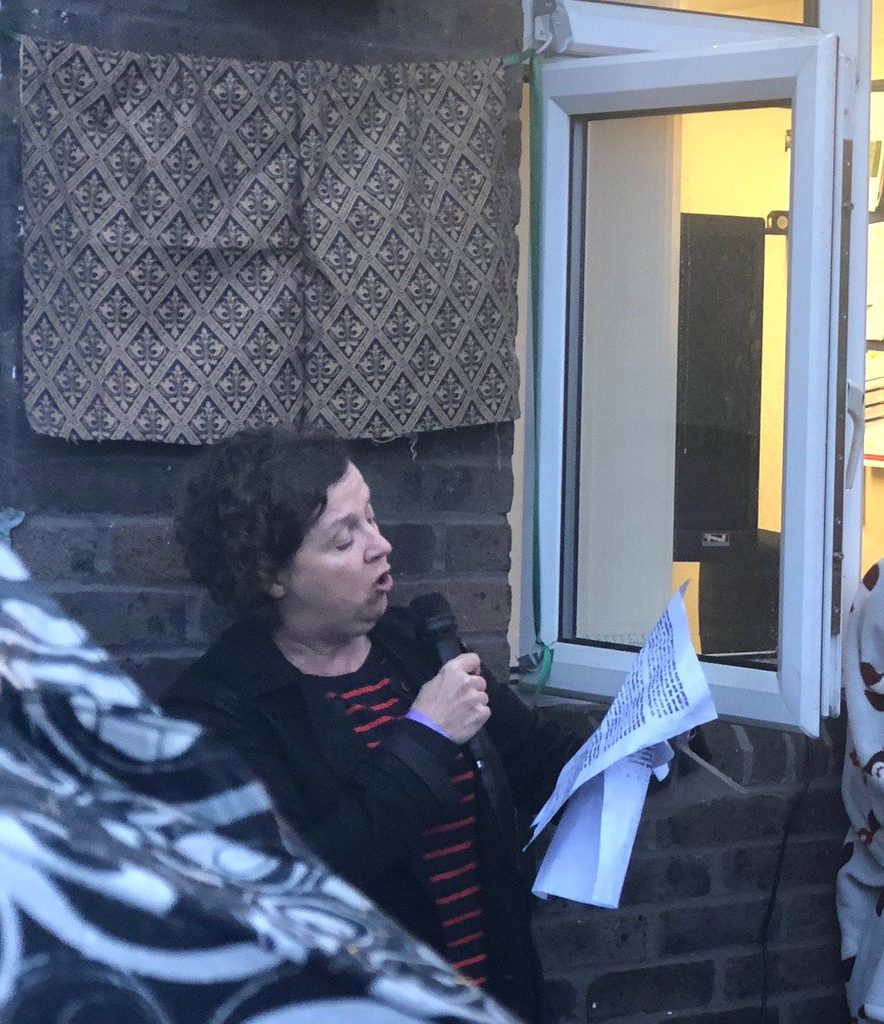
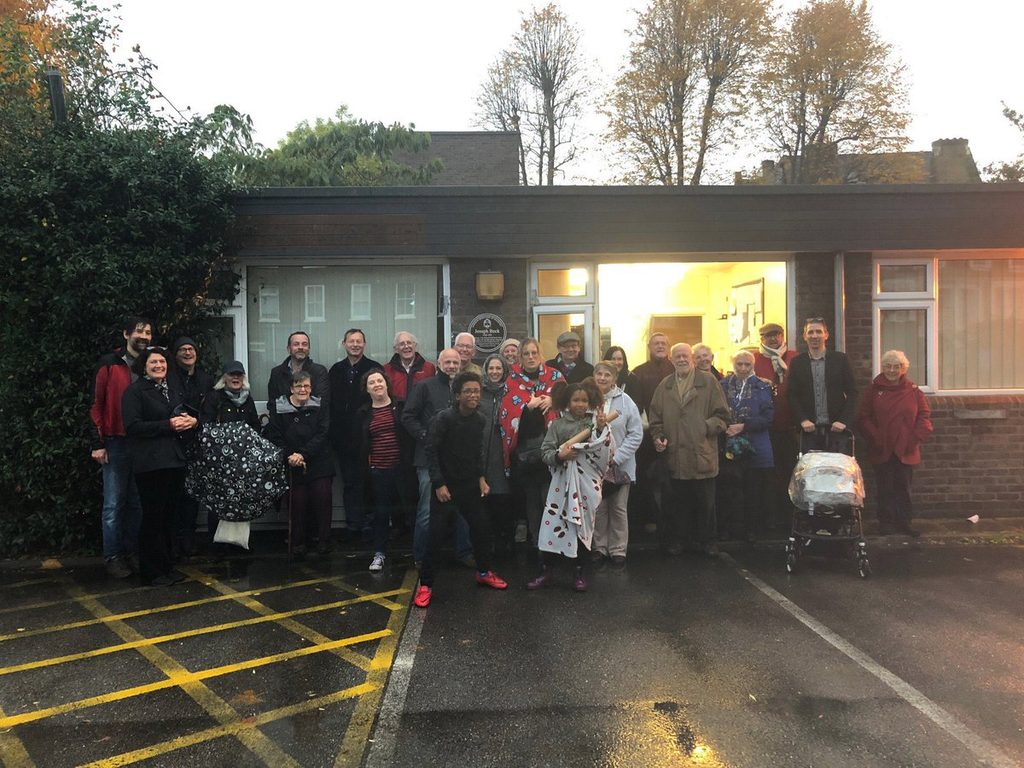
These projects extended our role beyond responding to present-day problems. They connected people using the park with the campaign that created it and with earlier generations who had used and cared for it.
Nature and wildlife
Concern for the park’s natural environment also runs through the archive.
The 1996 notices about habitats, pond dipping, the Nature Garden and Butterfly Tunnel show that this is not a recent addition to CPUG’s work. Tree care became a recurring subject in the 2000s, while later activities included bulb planting, wildlife surveys and volunteer care of the Butterfly Dome.
In 2016 CPUG requested a detailed discussion paper on biodiversity in Clissold Park. In subsequent years volunteers carried out surveys and practical activities, and the Nature Recovery work established in 2024 brought greater focus to habitat projects.
Recent activities have included hedging, nesting boxes, wildlife ramps, bat walks, litter picking and dead hedging. In May 2026 CPUG hosted eight corporate volunteers who worked in the Rose Garden and helped install three tit boxes and two robin boxes. Later that year volunteers cleared litter and larger discarded items from the exposed New River bed, while water lilies donated by Paul Brennels were planted through arrangements made by Biodiversity Representative Richard Crawford.
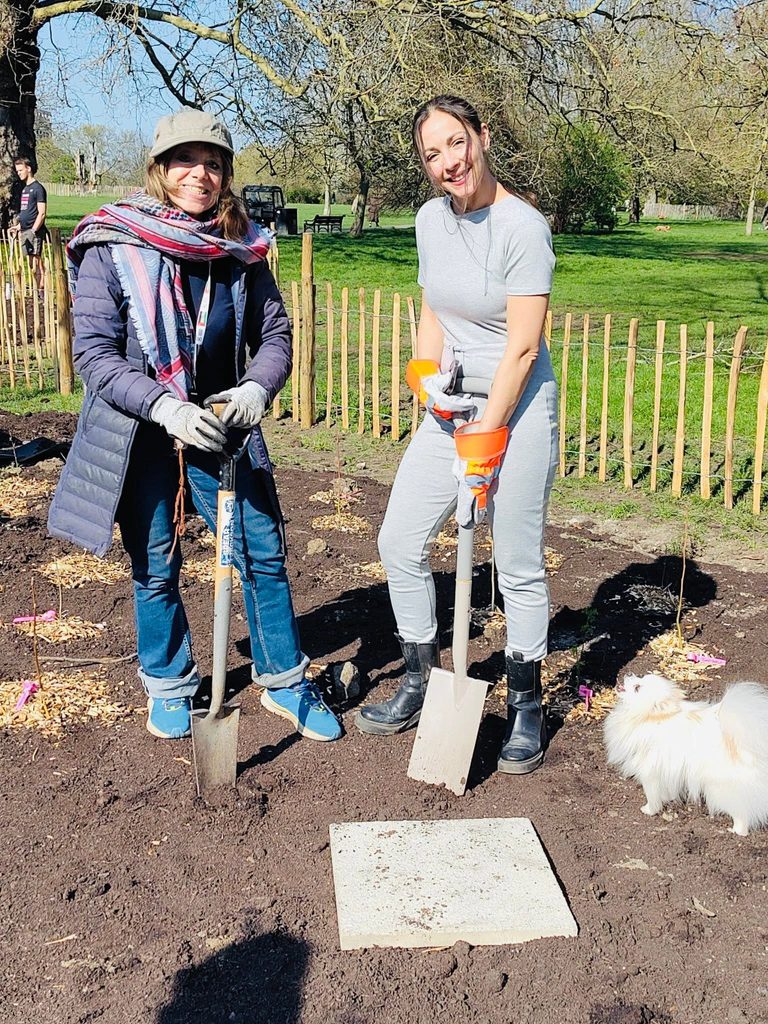
Not every intervention can be shown to have increased biodiversity, and the archive does not justify treating every Council nature project as a CPUG achievement. What it does demonstrate is a long history of park users raising ecological issues and, increasingly, taking part in practical work.
Events, fundraising and practical projects
Much of our history consists not of large campaigns but of smaller things organised year after year.
There have been children’s activities, walks, talks, music events, birthday celebrations, heritage displays, litter picks, tree walks, bat walks and fundraising events.
Money raised by the group has also been put back into the park and community activities. In 2022, for example, CPUG paid for new hedging along part of the Church Street boundary and contributed £650 to the Healthy Minds Healthy Bods walking programme. More recent funding has supported wildlife boxes and ramps.
In 2026 community fundraising resulted in a defibrillator being installed on the splash pad building, with CPUG taking responsibility for its annual maintenance. We also funded repairs and new locks for the park noticeboard.
These are modest projects compared with the restoration of the park and House, but they illustrate another part of what a volunteer user group can do: raise money locally and direct it towards specific needs.
Changing how we communicate
The ways in which CPUG communicates with park users have changed considerably.
Printed notices such as those surviving from the 1990s advertised meetings and invited anyone interested to come along. Newsletters subsequently provided updates about meetings, campaigns, events and changes in the park.
By 2002 Kate Last was developing a CPUG website. Isabelle Gore rebuilt the site in 2005 and went on to manage it for more than two decades, until 2026.
Email and online communication gradually became more important alongside the website, but face-to-face public meetings remained central.
The Covid-19 pandemic interrupted those meetings in 2020. CPUG continued publishing updates and communicating with park management, before an AGM in September 2021 marked the resumption of formal meetings. Online participation was introduced in 2022, allowing people to join remotely as well as in person.
The technology changed, but the underlying purpose was much the same as the words printed on those 1996 notices: everyone welcome.
New chairs, recurring questions
Mark Forsyth succeeded Caroline Millar as chair in March 2017, with Caroline continuing as Treasurer. Sophie Cameron became chair in May 2022, followed by Alexandra Hamit in July 2024.
Across these changes in leadership, familiar subjects kept returning in different forms.
Cycling, for example, had generated complaints about speed decades earlier. More recent discussions have included how cyclists and pedestrians share paths, painted warnings and cycle-safety activities. Dogs have moved from arguments about fouling and loose animals towards continuing discussion of responsible use of shared space. Children’s provision has moved from the playground construction and One O’Clock Club discussions of earlier decades to questions about accessible equipment and a new playground redevelopment.
The solutions and expectations have changed, but the underlying question remains much the same: how should a heavily used park accommodate people with different needs?
In 2019 CPUG adopted a complaints policy that explicitly distinguished our volunteer role from Hackney Council’s responsibility for operating and enforcing rules in the park. It formalised a distinction that can be seen throughout the earlier archive.
Generations of volunteers
The succession of chairs tells only part of CPUG’s story.
Over the decades the group has depended on people willing to become secretary or treasurer, represent a particular group of park users, organise an event, look after the website, research an issue, raise funds, take minutes or simply keep turning up to meetings.
Some names recur through many years of surviving records. Yvonne Hill, John Hudson, Caroline Millar, Hilde Oord, Daphne Steel and Betty Manning are among those whose involvement demonstrates that continuity. Some members have remained involved for more than a quarter of a century.
Different people have also taken responsibility for particular areas of work. Daphne Steel has served for many years as Dog Representative. Richard Crawford, our Biodiversity Representative, has been closely involved in biodiversity and Nature Recovery work. Isabelle Gore’s stewardship of the website from 2005 to 2026 represents more than two decades of work behind the scenes.
More recent volunteers have continued that pattern. Theresa Boden has taken on responsibilities within the group and is one of its current vice-chairs, while Amir Dotan’s involvement has included heritage, archive and website work.
These names are examples rather than a complete roll-call. Many more people appear in the records, and many others will have contributed without leaving much trace in the surviving archive. CPUG’s history has depended on people attending meetings, raising an issue, volunteering at an event, joining a working group, making a donation or offering their time.
CPUG today
Much of what we do in 2026 would be recognisable to members attending those meetings in the 1990s.
We continue to hold public meetings, raise issues with Hackney Council, organise activities, support projects and provide ways for people who use Clissold Park to become involved.
Recent work has included representing park users over proposals for a crossing beside the park, participating in playground consultation, raising accessibility concerns, organising volunteer work, supporting nature projects and pursuing repairs and improvements. The group has also continued to ask questions about the future use of park buildings and spaces.
As with the 1996 agenda that asked whether the Council’s parks service guarantee was adequate, representation does not necessarily mean getting the answer we want. Some issues are resolved quickly; others return to meeting agendas for years.
Hackney Council owns and manages Clissold Park and remains responsible for its maintenance and services. Our role is different. We provide an independent forum through which people who use the park can ask questions, contribute ideas, organise activities and collectively make their views heard.
That combination of representation, participation and practical action runs through the surviving history of Clissold Park User Group — from the earliest records we have found so far in 1989 to our work in the park today.
About this history
This account is based on our surviving archive, including meeting papers, newsletters, annual reports, correspondence, photographs and other documents.
The archive is incomplete. In particular, research into the group’s beginnings and its early chairs is continuing. Absence from the surviving records does not mean that an activity did not happen or that an individual was not involved.
We are continuing to reconstruct CPUG’s history. As more material is recovered and former and long-standing members contribute their recollections and records, we hope to add to this account.