Clissold Park has changed considerably over more than two centuries, from a private country estate on the edge of London to the public park at the heart of Stoke Newington today.
Understanding and sharing that history is part of CPUG’s work to care for the park and its heritage. This short history introduces some of the major events that shaped Clissold Park, with links to more detailed stories and research elsewhere in our Park History section.
From private estate to Clissold Park
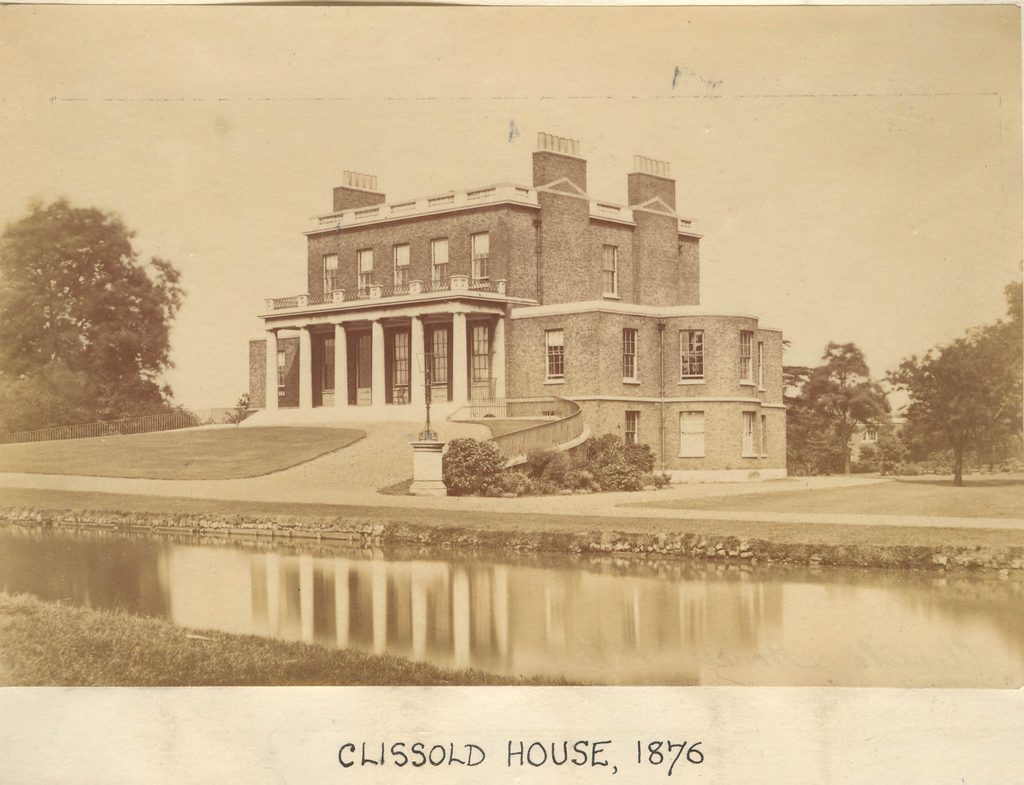
The story of Clissold Park begins in the late eighteenth century, when Jonathan Hoare, a Quaker merchant, began laying out an estate known as Stoke Newington Park. The house now known as Clissold House, a Grade II* listed late eighteenth-century villa, was completed by 1793.
The estate included parkland, woodland and two ponds, while the New River, constructed in the early seventeenth century to supply fresh water to London, ran through the grounds.
In the early nineteenth century the estate passed to Thomas Gudgeon and subsequently to William Crawshay. His daughter Eliza Crawshay married the Reverend Augustus Clissold, a local curate, and the house and estate eventually became known by the Clissold name.
The campaign to save Clissold Park
After Augustus Clissold’s death in 1882, the estate returned to the Crawshay family. George Crawshay subsequently sought to dispose of the property, while much of the surrounding land was owned by the Ecclesiastical Commissioners. The prospect of the estate being sold for housing development threatened one of the remaining open spaces in the rapidly growing area.
A campaign to preserve the land as a public park began in 1884. Two of its central figures were Joseph Beck, a Stoke Newington resident, manufacturing optician and City of London politician, and John Runtz, a member of the Metropolitan Board of Works (MBW). Public meetings, petitions and negotiations followed as campaigners sought to prevent development and secure the different interests in the land.
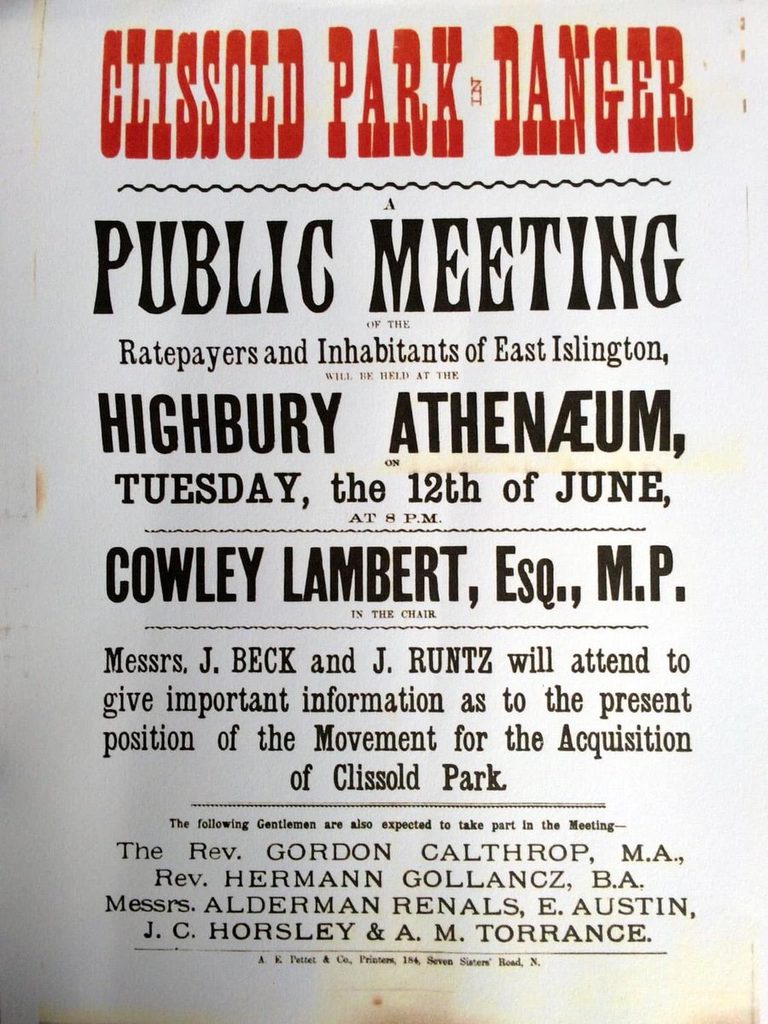
The campaign succeeded. Under the Clissold Park (Stoke Newington) Act 1887, the Metropolitan Board of Works was able to acquire the land, with financial contributions from local authorities and other bodies, and preserve it permanently as a public open space.
You can read the full story of how Clissold Park was saved and explore the Clissold Park Campaign Archive, which brings together around 175 original letters, newspaper reports, maps and other documents from the campaign.
A public park
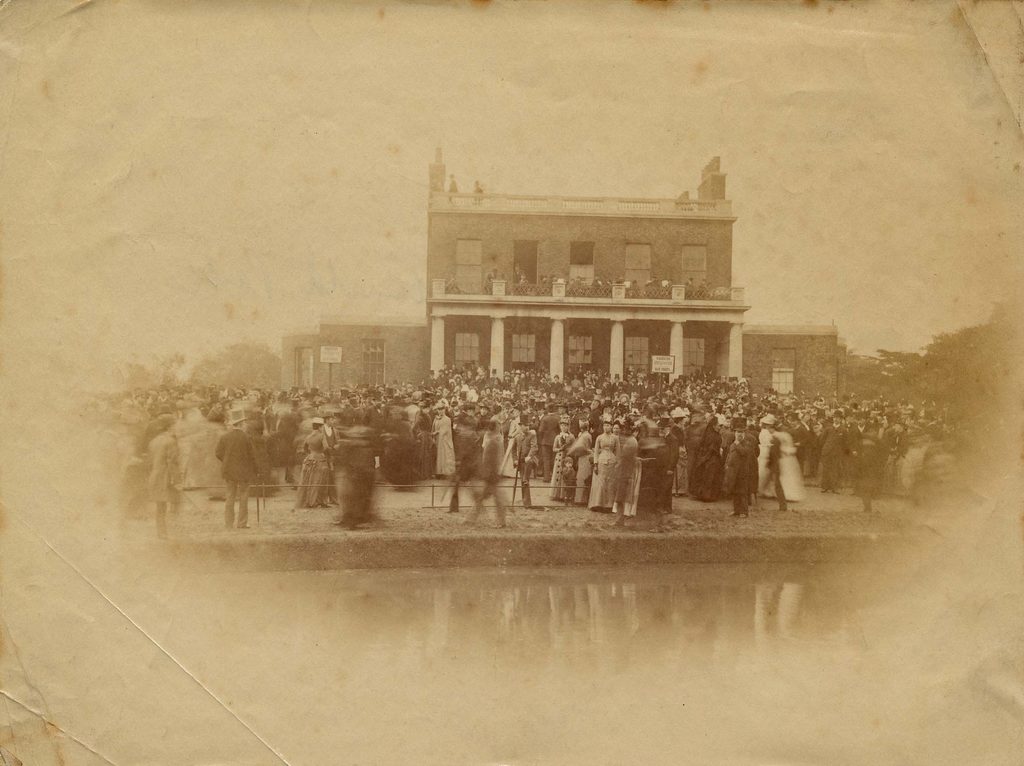
On 24 July 1889, Clissold Park was officially opened to the public by the newly formed London County Council (LCC), which had succeeded the MBW earlier that year.
A memorial drinking fountain dedicated to Joseph Beck and John Runtz was erected in the park in 1890, funded by donations from local residents. The park’s two ponds, Beckmere and Runtzmere, also commemorate the two campaigners and their roles in securing the park for the public.
More than a century later, as part of its heritage work, CPUG helped restore the Beck and Runtz Memorial Fountain and reinstate its missing decorative orb for the park’s 125th anniversary in 2014.
Joseph Beck is also commemorated beyond the park. In 2018, a heritage plaque was unveiled on Albion Road at the site of his former home. The project was initiated by CPUG’s Park History Representative, local historian Amir Dotan, with CPUG and Beck’s descendants contributing towards the plaque.
Clissold Park through the twentieth century
Following its opening, Clissold Park became an established public space serving the growing communities around it. The former private house became a public amenity, while the park developed and changed as successive generations used it for recreation, sport and community life.
Responsibility for the park passed from the London County Council to the Greater London Council and, following the abolition of the GLC in 1986, to Hackney Council.
Over time, some elements of the historic landscape were altered or lost. Sections of the New River running through the park were filled in, historic paths and views changed, and Clissold House and other structures eventually required substantial restoration.
This is also the period from which many of the photographs and memories of Clissold Park survive, recording changing fashions, activities and everyday life in the park.
Restoring Clissold Park and Clissold House
A major restoration of Clissold Park and Clissold House was completed in 2012, funded by Hackney Council and the Heritage Lottery Fund.
The project included:
- Restoring Clissold House and the Bowling Pavilion and bringing both back into public use
- Recreating a section of the historic course of the New River as a crescent-shaped pond opposite Clissold House
- Restoring paths and historic views that had been lost, including the original slope in front of Clissold House
- Replacing and restoring fencing, gates and other ornamental features.
The restoration helped recover important elements of the park’s historic landscape while adapting its buildings and facilities for contemporary use.
Clissold Park today
Today Clissold Park covers about 21 hectares (54 acres) and remains one of Hackney’s most important public green spaces. Its landscape still contains layers of its history: the eighteenth-century house and estate, the original ponds, the Victorian public park and features introduced or restored in more recent years. The crescent-shaped pond opposite Clissold House follows part of the former course of the New River, which once ran through the park but was shortened in 1946 to end at the East Reservoir. The pond seen there today is not part of the New River and is supplied independently.
The park is managed by Hackney Council. CPUG does not run or manage Clissold Park, but as an independent volunteer-run community group we work to represent people who use and care about the park and to help protect and improve it.
Keeping the park’s history alive
The campaign that created Clissold Park is more than a historical episode. The park exists as a public space today because local people organised to protect it from development.
CPUG continues that tradition of community involvement by working to protect and improve Clissold Park and by researching, sharing and helping preserve its heritage. Our heritage work ranges from preserving and commemorating physical reminders of the park’s history to researching its past and sharing what we discover through talks, publications, historical images and our online channels.
You can also watch a talk by Amir Dotan, CPUG’s Park History Representative, telling the story of how Clissold Park became a public park and the campaign that saved it from development.