Clissold Park could have been built on in the 1880s. It survives as a public park because local people organised a campaign to protect it from development and persuaded public bodies across north London to help buy it.
For CPUG, this is a particularly important part of the park’s history. The park that we work to protect and improve today exists because an earlier generation of local people came together to secure it for the public. Through our park heritage work, we help keep the story of that campaign alive through research and by preserving, commemorating and sharing the park’s history.
Much of the account below draws on research by our Park History Representative, local historian Amir Dotan. His research into the creation of Clissold Park has included digitising the surviving archive of the 1880s campaign and leading a community project to transcribe its 11,000-signature petition.
On this page
- The threat to Clissold Park
- Beck, Runtz and the preservation campaign
- Building public support
- Taking the campaign to Parliament
- Finding the money
- Opposition to the campaign
- The battle over Islington’s contribution
- A campaign repeatedly close to failure
- Closing the final funding gap
- Clissold Park opens to the public
- Remembering Beck and Runtz
- Rediscovering the campaign
- Watch the story
The threat to Clissold Park
By the 1880s, Stoke Newington and the surrounding districts were rapidly being developed and much of their remaining open land was disappearing. Clissold Park was still a private estate covering around 53 acres, centred on the house now known as Clissold House.
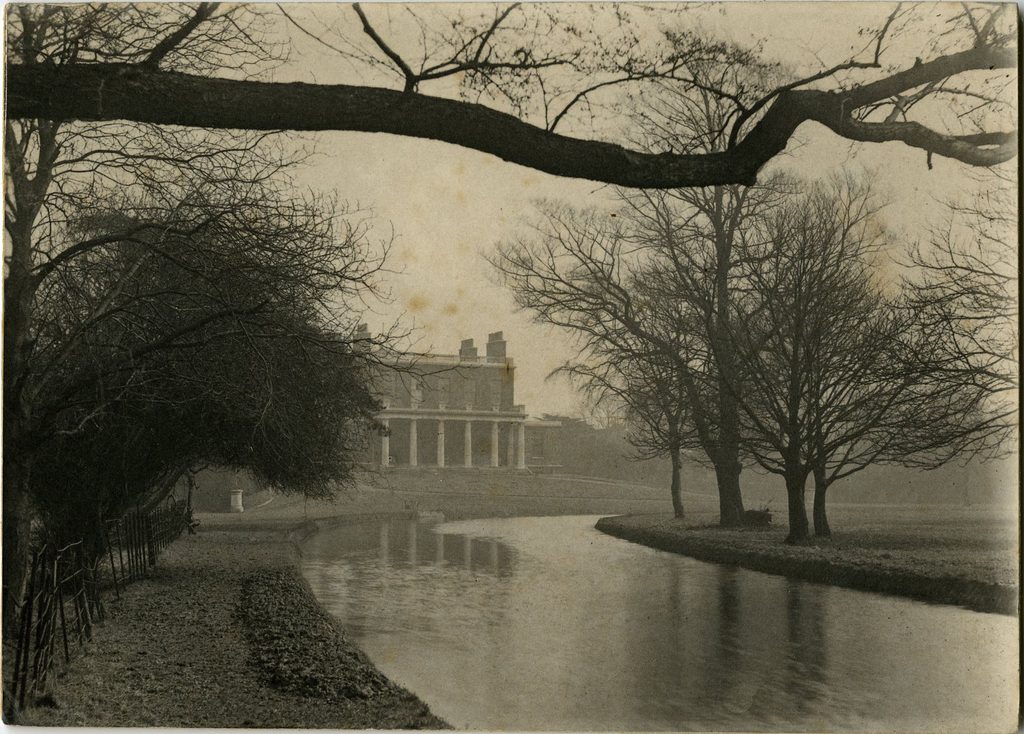
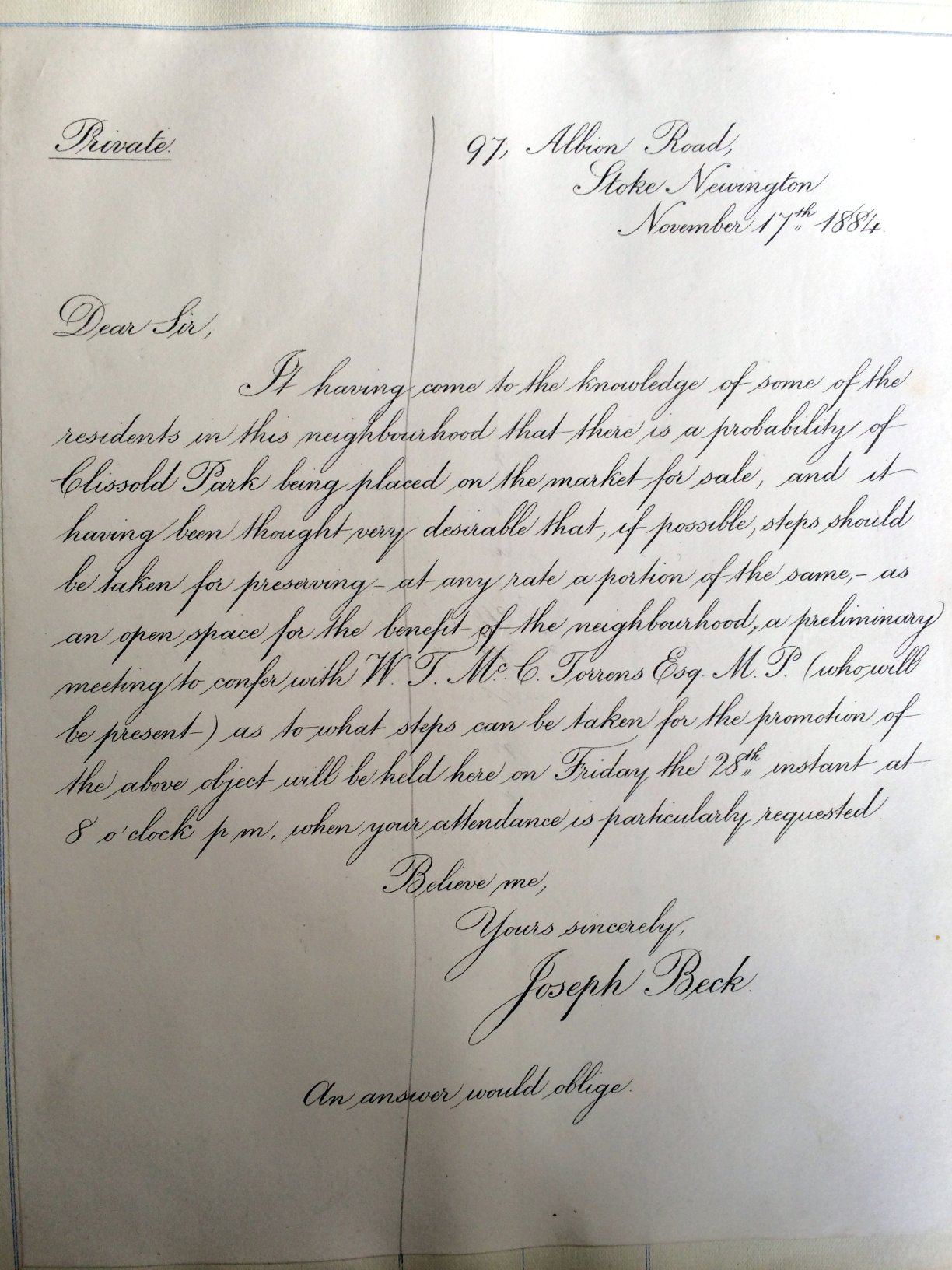
Concern about its future can be traced to 1884. George Crawshay, whose family owned the house and had an interest in the estate, approached local resident Joseph Beck about the possibility of selling part of it for public use. Beck quickly began bringing local people together to discuss whether the land could be preserved.
On 17 November 1884 he invited residents to a preliminary meeting at his home on Albion Road after hearing that Clissold Park might soon be placed on the market. His letter described the aim of preserving at least part of it as open space for the neighbourhood.
These early negotiations did not ultimately secure the park. The situation became much more urgent in 1886, when the Ecclesiastical Commissioners acquired the parkland and intended to make it available for building.
Beck, Runtz and the preservation campaign
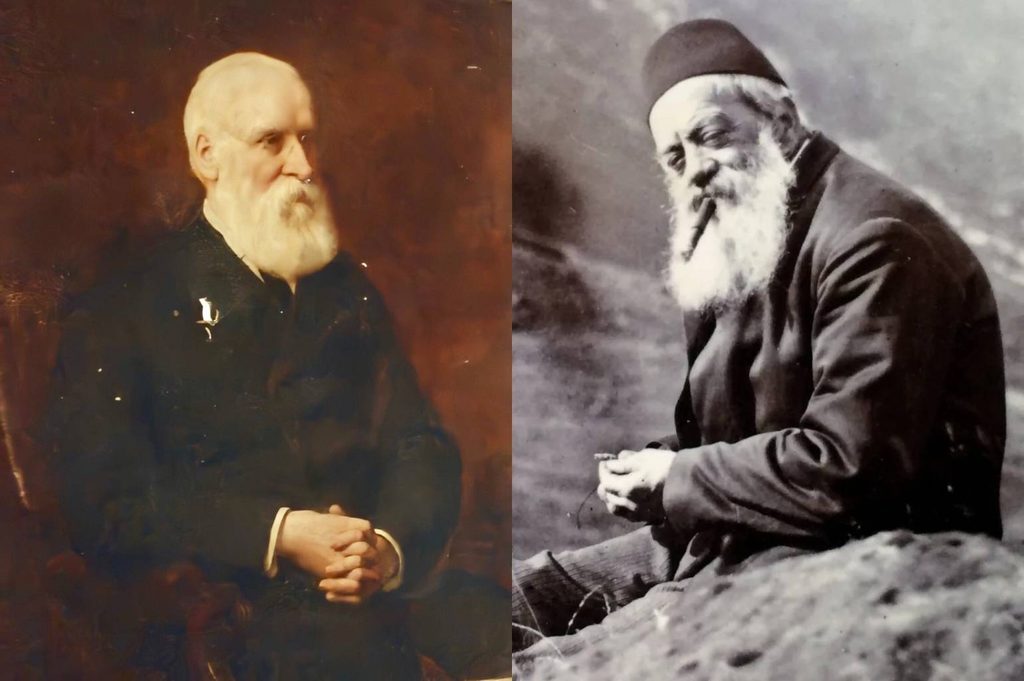
The leading figures in the campaign were Joseph Beck and John Runtz.
Beck was a Stoke Newington resident, manufacturing optician and City of London politician. Runtz represented Stoke Newington on the Metropolitan Board of Works, the body then responsible for major infrastructure and public works across London. Together they provided the campaign with local organisation, political connections and persistent leadership.
A major public meeting was held at the Stoke Newington Assembly Rooms in Defoe Road on 30 June 1886. Chaired by Beck and attracting considerable public and press attention, it led to the formation of the Clissold Park Preservation Committee, with Beck as chairman. Its objective was to secure the estate permanently as a public open space.
Building public support
The campaign developed on several fronts. The committee organised public meetings and deputations, lobbied politicians and public authorities, wrote to the press and sought financial commitments from the different bodies whose residents would benefit from the park.
A huge petition demonstrated the scale of local support. Around 11,000 people, principally from Stoke Newington, Hackney and Islington, added their names and addresses in support of preserving Clissold Park.
The campaigners argued that retaining open space was increasingly important for the health and recreation of people living in a rapidly urbanising part of London. They also had to make a practical case for spending public money on acquiring the estate.
The process was far from straightforward. Different authorities had different interests, and the fact that Clissold Park lay in Stoke Newington while also serving people in neighbouring districts repeatedly raised the question of who should pay for it.
Taking the campaign to Parliament
Securing public support was not enough. The campaign needed the legal powers and money necessary to purchase the estate.
A private Bill was promoted in Parliament to enable the acquisition of Clissold Park. Even this encountered a serious obstacle: in early 1887 the Metropolitan Board of Works itself formally opposed the Bill.
The committee responded with further lobbying and deputations. In July 1887 a deputation led by Beck went to the Metropolitan Board of Works asking it to contribute towards the purchase. The campaign eventually succeeded in changing the Board’s position.
The resulting Clissold Park (Stoke Newington) Act 1887 provided the mechanism through which the park could be acquired and preserved for public use.
Passing the Act, however, did not mean the park had been saved. The necessary money still had to be found.
Finding the money
The purchase depended on assembling a substantial package of funding from several different public bodies and institutions.
By late 1887 the campaign had made major progress. The City authorities committed a large contribution from the City Parochial Charities Fund, the Metropolitan Board of Works pledged further funding, and Stoke Newington Vestry agreed to contribute £10,000.
But there was still a significant shortfall, and obtaining contributions from neighbouring districts proved one of the most contentious parts of the entire campaign.
Opposition to buying the park
Not everyone thought public money should be spent on Clissold Park.
Opponents questioned why ratepayers should contribute towards a park lying outside their own district. Some argued that other public needs deserved the money more, while others maintained that existing open spaces such as Finsbury Park were sufficient.
There were also accusations that the campaign principally benefited the relatively prosperous people who lived close to Clissold Park.
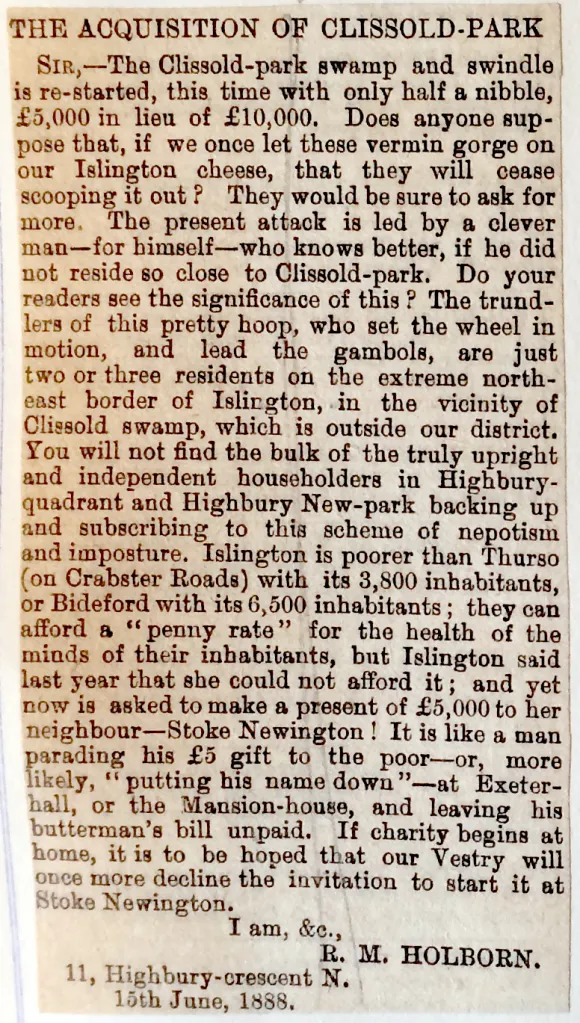
The debate could become remarkably hostile. One opponent, R. M. Holborn of Highbury Crescent, wrote to the press in June 1888 attacking the proposal for Islington to contribute towards the purchase. He described the scheme as a “swamp and swindle”, accused its supporters of self-interest and argued that Islington’s ratepayers should not have to subsidise neighbouring Stoke Newington.
The battle over Islington’s contribution
Islington became the focus of some of the fiercest arguments.
The campaign initially sought a contribution of £10,000 from Islington. Supporters organised meetings and argued that the 53-acre park, close to Islington’s northern boundary, would provide an important open space for Islington residents as well as those in Stoke Newington.
But the proposal generated months of opposition and disorderly Vestry debates. The proposed contribution fell from £10,000 to £5,000 and was eventually reduced to only £2,500.
At a special Islington Vestry meeting in July 1888, even the £5,000 proposal became the subject of prolonged procedural arguments and debate about whether the whole parish should pay. An amendment reducing the contribution to £2,500 was ultimately carried by 65 votes to 3.
The reduction left the campaign once again facing a funding gap at the very point when success seemed close.
A campaign that repeatedly came close to failure
Islington was not the only complication.
Hackney eventually pledged £5,000, although there was briefly uncertainty over the legality of its contribution. South Hornsey offered £6,000, but its proposed contribution encountered a problem because of local authority boundary restrictions.
Beck and the committee therefore had to continue lobbying, negotiating and reassuring supporters while the financial arrangements shifted around them.
The surviving correspondence and newspaper reports make clear that success was by no means inevitable. At several points supporters feared the scheme might collapse, and Beck repeatedly wrote publicly to counter reports that the campaign had failed or been abandoned.
This uncertainty is an important part of the story. Clissold Park was not secured by a single decision or straightforward purchase, but through years of negotiation between campaigners, ratepayers, local authorities, the Metropolitan Board of Works, the City and the Ecclesiastical Commissioners.
The final gap is closed
By July 1888 the campaign was tantalisingly close to raising enough money.
After Islington finally agreed its £2,500 contribution, a remaining shortfall still had to be resolved. The Ecclesiastical Commissioners agreed to waive accumulated interest on the purchase money, effectively closing the final gap.
The park could at last be regarded as secured for the public. Contemporary reports singled out Beck’s persistence in bringing the long campaign to a successful conclusion.
The final funding package brought together contributions from a remarkable coalition of public bodies and institutions. That was both the campaign’s great difficulty and, ultimately, one of its achievements: organisations representing different parts of London had been persuaded to cooperate to preserve a major open space.
Clissold Park is secured for the public
The purchase arrangements were subsequently completed and the park passed into public hands.
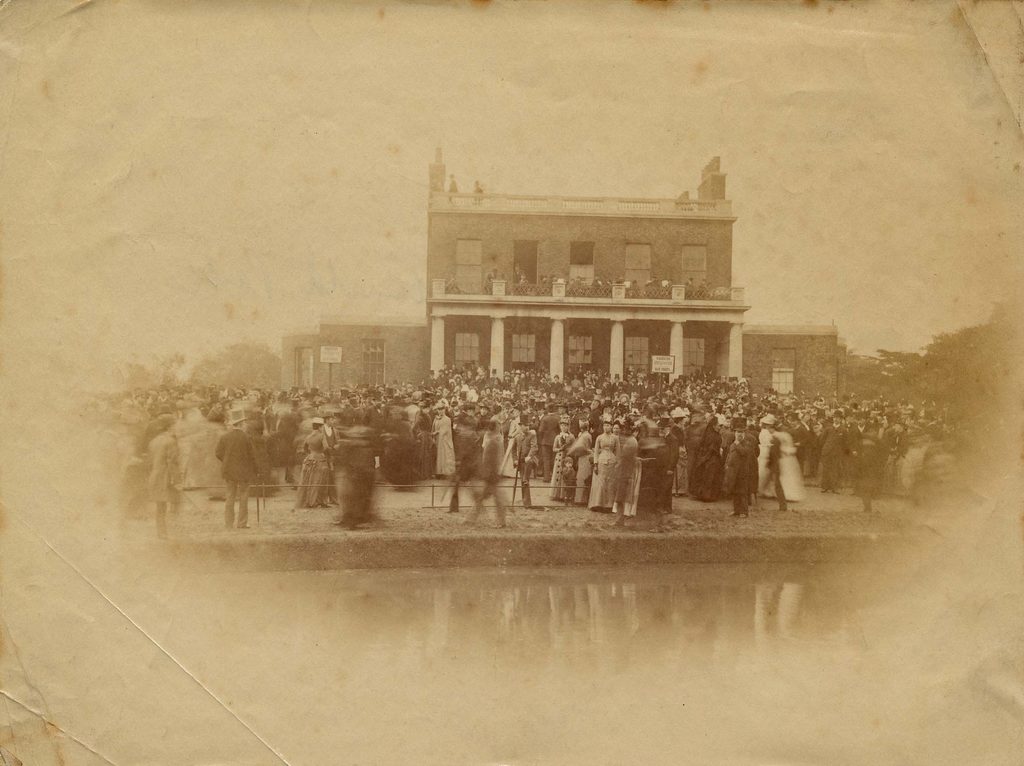
In March 1889 the Metropolitan Board of Works was replaced by the newly created London County Council. It was therefore the LCC that formally opened Clissold Park on 24 July 1889.
The Earl of Rosebery, chairman of the LCC, performed the opening ceremony. Thousands of people attended, with speeches, a symbolic presentation of the park’s key and even the firing of a cannon before the crowds entered the newly opened public space.
What had been a private estate threatened with development was now permanently available for public use.
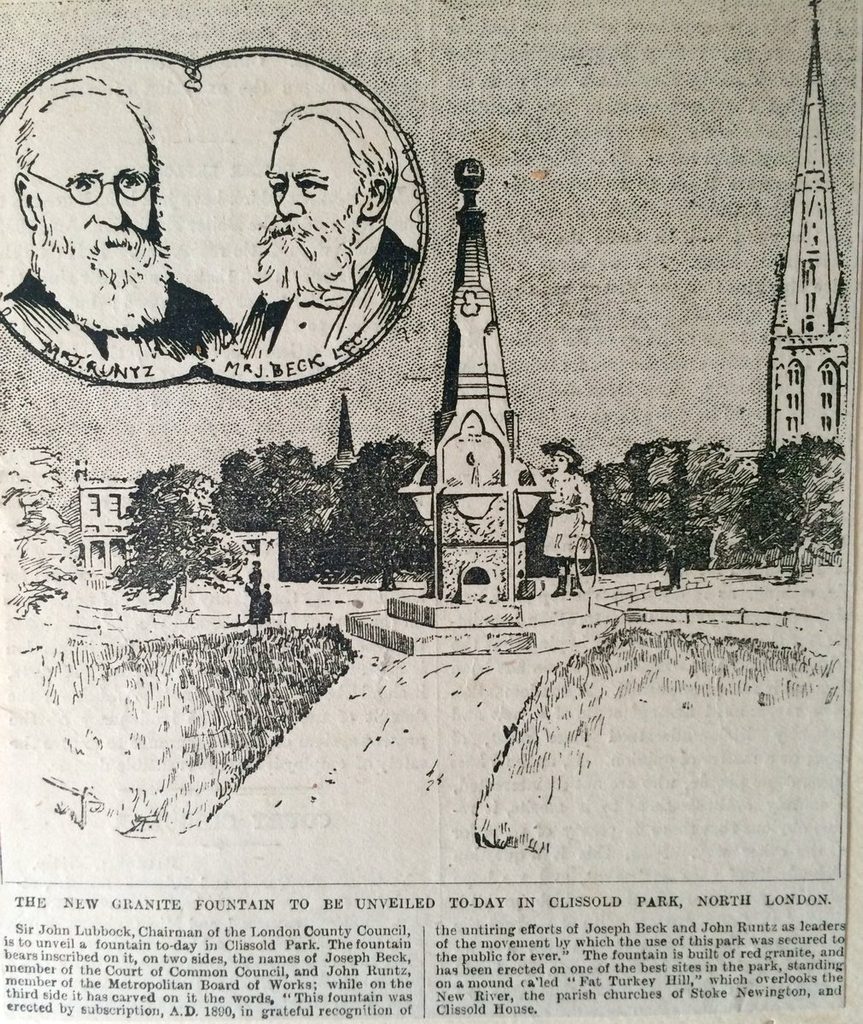
Beck and Runtz were recognised for their roles in securing the park. A commemorative fountain dedicated to them was erected in Clissold Park in 1890, funded by donations from local residents. The park’s two lakes were also named after them: the larger Beckmere after Joseph Beck and the smaller Runtzmere after John Runtz.
Both men died in 1891.
Remembering Beck and Runtz
Beck and Runtz were recognised for their roles in securing the park. A commemorative fountain dedicated to them was erected in Clissold Park in 1890, funded by donations from local residents. The park’s two lakes were also named after them: the larger Beckmere after Joseph Beck and the smaller Runtzmere after John Runtz.
More than a century later, CPUG helped restore the Beck and Runtz Memorial Fountain and reinstate its missing decorative orb as part of the park’s 125th anniversary celebrations in 2014. The restored fountain was unveiled on 24 July 2014, exactly 125 years after Clissold Park opened to the public. You can read more about the restoration and CPUG’s wider heritage work.
CPUG also contributed towards a heritage plaque marking the site of Beck’s home on Albion Road, close to Clissold Park. The project was initiated by Amir Dotan in 2017, working with Barton House GP, Hackney Council, CPUG and members of Beck’s family.
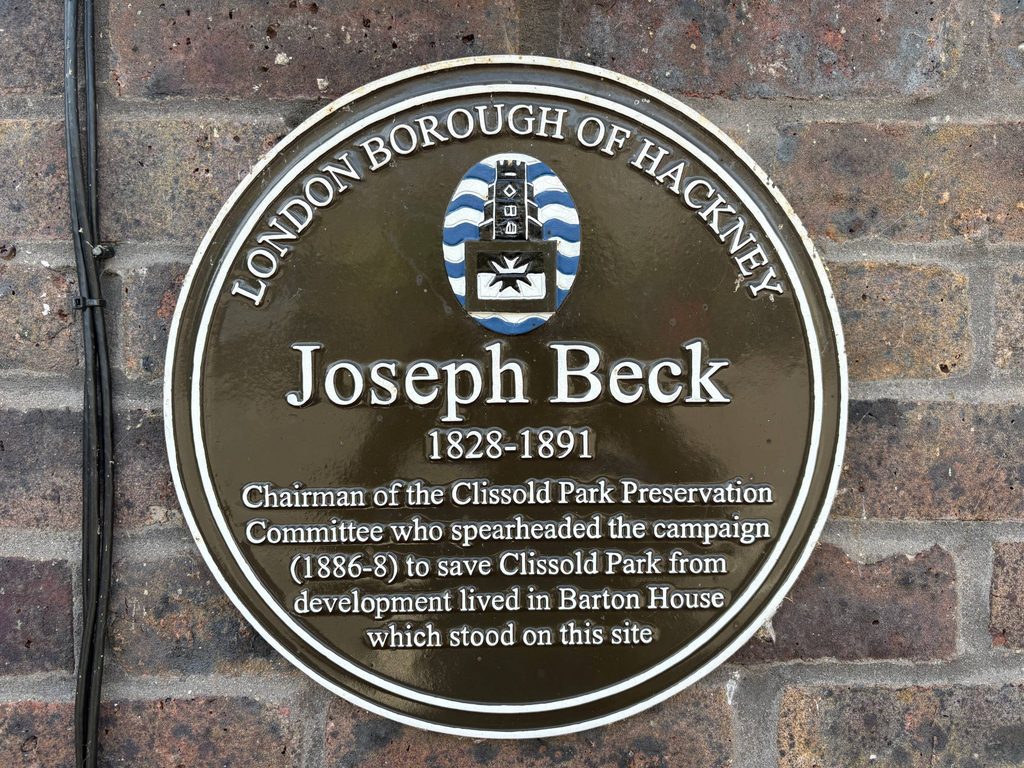
The plaque was funded by CPUG and members of Beck’s family and unveiled outside Barton House GP on 10 November 2018. The event brought descendants of Beck and Runtz together for the first time in nearly 130 years.
Rediscovering the campaign
Much of what we now know about the campaign survives because a remarkable collection of material was preserved by Joseph Beck’s descendants.
The collection contains around 175 letters, newspaper cuttings, meeting notices, maps and other documents, recording the campaign in extraordinary detail. Together they reveal not just its major milestones but its arguments, setbacks, personalities and day-to-day political manoeuvring.
In 2015, local historian and CPUG Park History Representative Amir Dotan was given access to the collection. He photographed the material and subsequently created the Clissold Park Campaign Archive to make it publicly accessible. The archive has since been transcribed and catalogued, allowing the campaign to be followed almost document by document.
The original 1886 petition also survives at the London Metropolitan Archives. Its 412 pages contain around 11,000 names and addresses. In 2021, Amir organised a community project to transcribe it, with 40 volunteers completing the task in just 19 days.
These independent research projects have transformed how much can be known about the campaign and provide the basis for much of the account on this page.
Watch the story
Watch Amir Dotan’s talk about the creation of Clissold Park and the campaign that saved it from development.
Drawing on material from the surviving campaign archive, the talk tells the story of the people, politics and negotiations behind the effort to secure the estate and open it as a public park in 1889.
You can also listen to Joseph Beck’s 1888 letter to the Weekly Recorder, read by his great-grandson Jonathan Shaw and accompanied by a photo montage of the park.